
From Postgres to ClickHouse: Achieving Real-Time Aggregations with Materialized Views and Cutting Costs by 80%

Written by Vasu Gupta
December 08, 2025 — 7 Min Read | 0 Comments
Overview
In the pursuit of real-time analytics at scale, teams often face a key architectural decision: continue scaling traditional relational databases like PostgreSQL or migrate to analytical columnar databases like ClickHouse.
This post explores a real-world migration from a Postgres-based aggregation pipeline to a ClickHouse architecture leveraging Materialized Views (MVs).
We’ll dive deep into:
- The motivation behind the migration
- How ClickHouse MVs simplify real-time aggregation
- Performance and cost outcomes
- A detailed comparison between Postgres and ClickHouse
- Lessons learned and best practices
The Legacy: Postgres Recording Pipeline
Data Flow
- DACDN ingested real-time event data.
- Data was processed and aggregated through a Recording Pipeline (write layer).
- The processed aggregated events were persisted in a Postgres table.
- Read Queries consumed aggregated results from Postgres.
Pain Points
Despite Postgres’s robustness and ACID compliance, several scalability issues arose:
- High operational overhead: Maintaining both the Recording Pipeline and Postgres at scale required significant infrastructure and engineering investment.
- Performance bottlenecks: Query performance degraded as datasets grew, particularly for real-time analytics workloads.
- Data duplication: Redundant data persisted across multiple systems for ingestion and query optimization.
- Limited scalability: Vertical scaling (more CPU, RAM) reached diminishing returns, while sharding introduced complexity.
The Modernized Architecture: ClickHouse with Materialized Views
ClickHouse's Materialized Views Internal Working
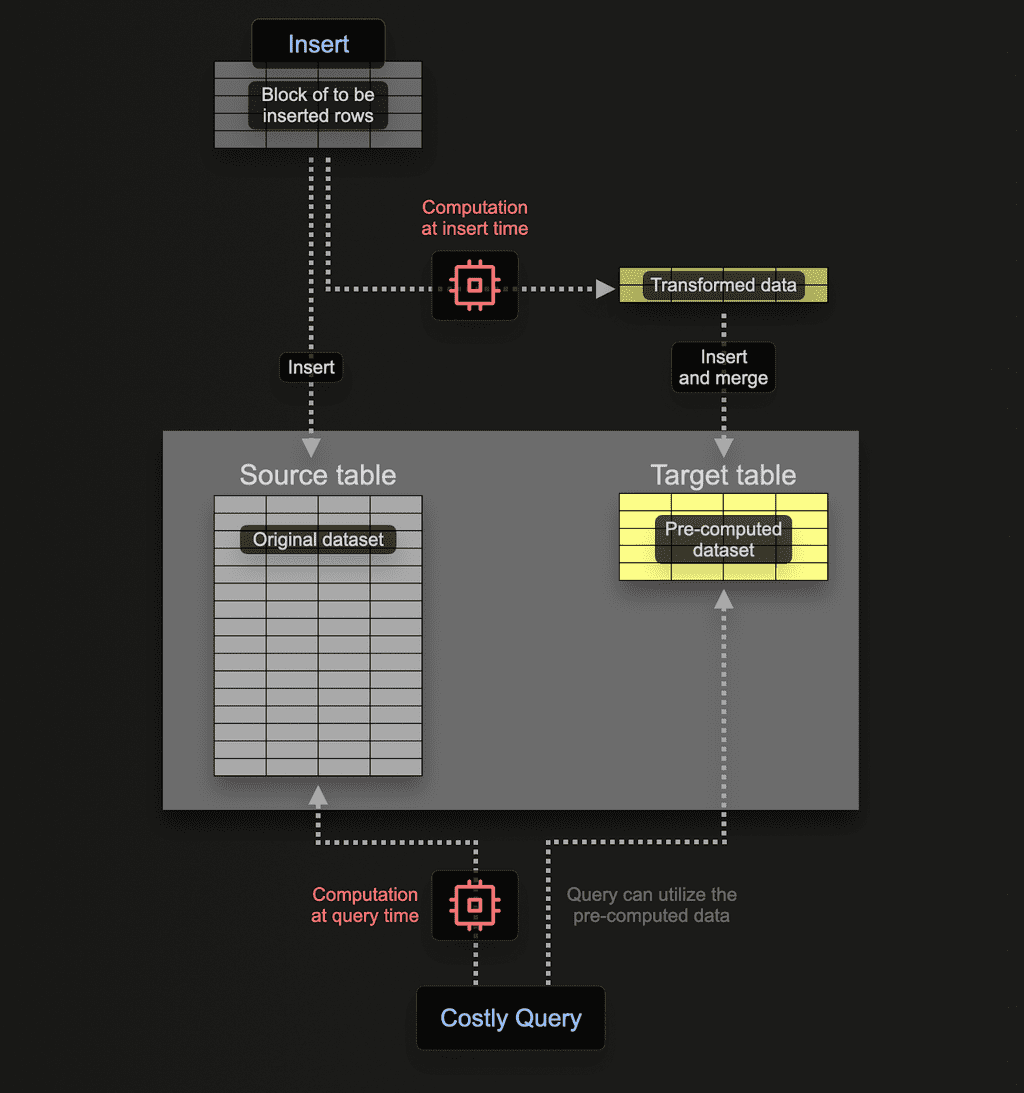
Image source: ClickHouse Materialized Views Documentation
Our High-Level Architecture

New Data Flow
- DACDN remains the data ingestion entry point.
- Data flows into the ClickHouse Pipeline (write layer).
- Events are written to the base raw events table (
raw_events_table). - A Materialized View (MV) performs real-time aggregations into
agg_recordings_table. - Read queries now directly query the MV for high-performance reads.
Benefits
| Improvement | Description |
|---|---|
| Performance Boost | ClickHouse’s columnar engine and compression deliver faster analytical queries. |
| Simplified Architecture | Eliminates the Recording Pipeline and Postgres, unifying real-time ingestion and analytics. |
| Cost Efficiency | Reduces infrastructure footprint — fewer moving parts, less operational overhead. |
| Real-Time Aggregation | Materialized Views compute aggregates automatically as data arrives. |
| Scalability | ClickHouse efficiently handles billions of events with horizontal scaling and sharding. |
| Flexibility | Compute power is isolated from storage, providing flexibility to scale resources based on needs. |
Under the Hood: ClickHouse Implementation
Base Table
Raw events are ingested into sharded_database.raw_events_table. This table stores raw events in a highly compressed, columnar format.
Aggregation Table
The agg_recordings_table uses the AggregatingMergeTree engine — perfect for pre-aggregated data.
CREATE TABLE sharded_database.agg_recordings_table
(
    `account_id` UInt32,
    `uuid` String,
    `session_id` DateTime,
    -- additional dimensions/measures
)
ENGINE = AggregatingMergeTree
PARTITION BY toStartOfMonth(session_id)
ORDER BY (account_id, session_id, uuid)
TTL ...
SETTINGS storage_policy = '...';
Materialized View Logic
CREATE MATERIALIZED VIEW sharded_database.recordings_daily_mv_v1
TO sharded_database.agg_recordings_table
AS SELECT
    account_id,
    uuid,
    coalesce(session_id, toDateTime(0)) AS session_id,
    -- aggregate functions here (e.g., countState(), sumState(), uniqState())
FROM sharded_database.raw_events_table
WHERE /* filtering conditions */;
This MV runs continuously — new data triggers aggregation automatically, making the latest analytics instantly queryable.
Migration Workflow
Schema Setup
- Create an aggregated (
agg_recordings_table) table (raw_events_tablewas already present for raw events). - Deploy Materialized View logic.
Historical Data Copy
- Migrate historical data from PostgreSQL's aggregated table or ClickHouse's raw events table into ClickHouse's recordings aggregated table.
Validation
- Compare aggregation outputs between PostgreSQL and ClickHouse to ensure parity.
- Validate query results consumed by read queries.
Cutover
- Redirect read queries to the ClickHouse MV.
- Deprecate the PostgreSQL pipeline.
Cleanup
- Decommission the old PostgreSQL infrastructure to save costs.
Benchmark Insights
While exact metrics vary by dataset, general trends show:
| Metric | Postgres | ClickHouse |
|---|---|---|
| Query latency (99th percentile) | 30–50 seconds | 100–300 ms |
| Storage footprint | High (row-store) | 75% reduction in storage (columnar) |
| Operational overhead | High | Low |
| Cost efficiency | Moderate | Excellent |
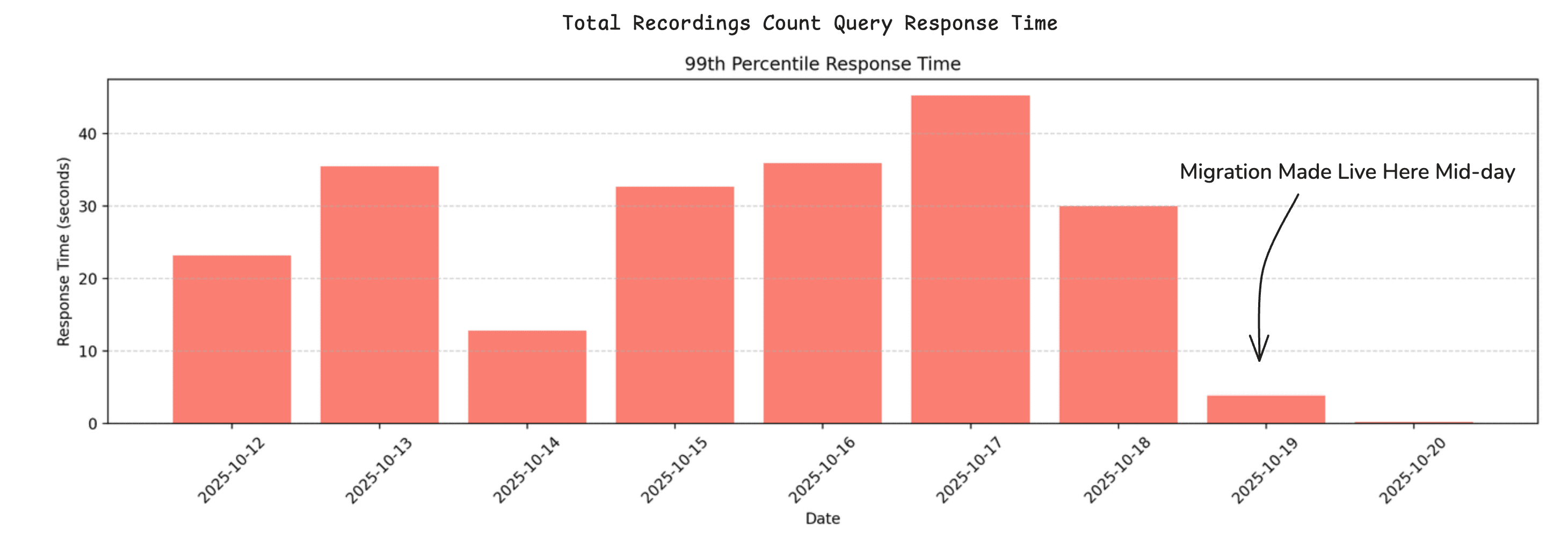
PostgreSQL vs ClickHouse: A Deep Dive
| Aspect | Postgres | ClickHouse |
|---|---|---|
| Storage Model | Row-oriented | Columnar |
| Ideal Workload | OLTP (transactions) | OLAP (analytics) |
| Indexing | B-tree, GIN, BRIN | Sparse indices, partitions |
| Aggregation Performance | Slower on large datasets | Optimized for massive aggregates |
| Materialized Views | Manual refresh required | Real-time, automatically updated |
| Schema Flexibility | High | Moderate (needs defined schema) |
| Joins | Strong relational joins | Limited but improving |
| Updates/Deletes | ACID, strong consistency | Eventual consistency, append-optimized |
| Scalability | Vertical scaling | Horizontal (cluster-friendly) |
| Ecosystem | Mature, rich tooling | Rapidly evolving, modern |
Lessons Learned
- Design for immutability: ClickHouse thrives with append-only workloads.
- Leverage partitioning: Time-based partitions (
toStartOfMonth) optimize queries and TTL-based cleanup. - Balance MVs: Over-aggregating can limit flexibility; under-aggregating can hurt performance.
- Monitor ingestion lag: High write rates can cause merge delays.
- Schema evolution requires care: Adding new columns or changing types requires explicit handling.
Why not ClickHouse’s Projections
Why Materialized Views Are Better Than Projections for This Task
- Explicit Schema and Separate Storage: Materialized views store results in their own table with a defined schema, giving more flexibility for complex denormalization. Projections, on the other hand, are tied to the main table and are mostly invisible.
- Real-Time Updates: Materialized views automatically update as new data is inserted, making them ideal for continuous, real-time aggregation. Projections focus on optimizing queries over existing data rather than live updates.
- Complex Transformations and Chaining: Materialized views can perform multi-step transformations and be chained together, enabling powerful data pipelines. Projections cannot be chained.
When to Choose ClickHouse
Choose ClickHouse if your workloads are:
- Analytical and read-heavy
- Require sub-second aggregation queries on billions of rows
- Can tolerate eventual consistency
- Involve streaming or real-time data processing
Choose PostgreSQL if your workloads are:
- Transactional or highly relational
- Require strong consistency guarantees
- Involve frequent row-level updates or joins across normalized data
Final Thoughts
The migration from PostgreSQL to ClickHouse marked a significant leap in scalability, performance, and simplicity. By leveraging Materialized Views, the engineering team unlocked near real-time insights, reduced infrastructure complexity, and cut operational costs by 80%.
This evolution reflects a broader industry trend:
“Move compute closer to the data, automate aggregation, and design for scale from day one.”
As data volumes continue to grow, ClickHouse represents a powerful paradigm for modern analytics engineering — fast, efficient, and purpose-built for the age of streaming data.